

Karachi has seen some interesting solutions to its never-ending traffic problems, but this one may have caught everyone off guard: a bicycle ambulance.
Karachi Mayor Murtaza Wahab recently visited Orangi Town to inaugurate a new operational base of the Sindh Integrated Emergency and Health Services (SIEHS), the organization behind the province’s Rescue 1122 ambulance network.
The emergency base has been shifted from Kati Pahari to a government-owned building near Banaras, with the aim of improving response times in Orangi Town and other densely populated areas.
So far, so good.
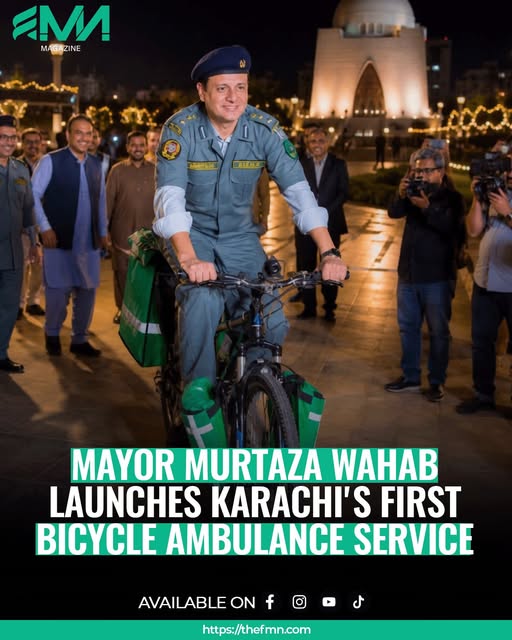
But then came the moment that got social media talking: the mayor hopped onto a bicycle ambulance.
And yes, it looks exactly like what you’re imagining.
Wait… Is That Actually an Ambulance?
Before anyone starts imagining a patient being rushed to the hospital on the back of a bicycle, there’s an important detail: bicycle ambulances are not new.
Rescue 1122 introduced Karachi’s bicycle ambulance service back in May 2025.
The idea is actually fairly practical. Karachi has plenty of neighborhoods where roads are so narrow, crowded or blocked by traffic that a conventional ambulance can spend precious minutes simply trying to reach the patient.
A bicycle, on the other hand, can squeeze through places where a full-sized ambulance would basically need a miracle—and perhaps a police escort.
SIEHS has also displayed mountain-bike ambulances as part of its emergency fleet and introduced female rapid-response bicycle teams during 2025.
But Why Is Everyone Making Fun of It?
The internet, being the internet, naturally had questions.
For many people, the bicycle’s extremely basic appearance made the initiative look less like an emergency innovation and more like “Karachi traffic finally defeated the ambulance.”
The sight of the mayor personally riding the pedal-powered vehicle also gave social media plenty of material.
Critics questioned whether a bicycle ambulance should be presented as a major technological achievement when Karachi continues to struggle with bigger issues involving healthcare, transportation and emergency infrastructure.
And let’s be honest: if your city has potholes large enough to qualify as swimming pools, the phrase “advanced emergency transport” is going to invite a few jokes.
Okay, But Does the Bicycle Actually Make Sense?
Surprisingly, yes.
A bicycle ambulance obviously isn’t going to replace a conventional ambulance. It can’t transport a patient to the hospital, carry extensive life-support equipment or provide the space and protection of a proper road ambulance.
Nobody is going to be loading a patient onto it and shouting, “Chalo bhai, hospital!”
That’s not the point.
The bicycle is designed for first response.
In crowded markets, narrow streets and heavily congested neighborhoods, a trained responder on a bicycle may be able to reach a patient several minutes before a larger ambulance.
Those few minutes can matter.
A responder can assess the situation, provide first aid and begin stabilizing the patient while a conventional ambulance makes its way through Karachi’s legendary traffic.
So, Is It a Joke or Actually Useful?
Perhaps a little bit of both.
The bicycle ambulance may look funny—and watching a mayor inaugurate an emergency service by riding one certainly makes for a memorable headline.
But underneath the memes is a fairly simple idea: sometimes the fastest emergency vehicle isn’t the biggest one.
The real question isn’t whether a bicycle looks impressive. It’s whether it can help emergency responders reach people faster.
In a city where traffic can turn a 10-minute journey into a small documentary series, maybe the humble bicycle deserves a chance.
Just don’t expect it to start competing with Formula 1 anytime soon.